
Tour two nurseries in the same week and you may hear both described as “child-led”, “play-based” and “hands-on”. The words overlap, but the days don’t. When parents weigh EYFS vs Montessori, the real question is who decides what happens next: a teacher planning around a framework, or a child choosing from a carefully prepared room.
If you’re shortlisting a nursery in Sharjah, this guide explains how each approach works, what a morning looks like in each, what the research does and doesn’t show, and how to check what a nursery actually does behind the label.
The Short Answer
The EYFS is a framework. It sets out what young children should learn and how adults should support them, but it leaves the teaching method to the nursery.
Montessori is a method. It prescribes a particular way of arranging the room, the materials, the age groups and the time children spend on their own chosen work.
Because one describes what and the other describes how, many UAE nurseries combine them. That’s also why the label on the gate tells you less than a morning spent in the classroom.
What Is the EYFS?
The Early Years Foundation Stage is England’s statutory framework for children from birth to five. Nurseries in the UAE that describe themselves as “British curriculum” usually follow it by choice, while being licensed and inspected locally. In Sharjah, private nurseries come under the Sharjah Private Education Authority (SPEA). The current EYFS framework took effect on 1 September 2026.
The Seven Areas of Learning
The EYFS groups learning into three prime areas and four specific areas.
- Prime areas: communication and language; physical development; personal, social and emotional development
- Specific areas: literacy; mathematics; understanding the world; expressive arts and design
The prime areas come first, because they underpin everything else a young child learns.
How EYFS Teachers Work
The framework states plainly that play is essential for children’s development. Children learn by leading their own play and by joining in play and activities that adults guide. Teachers plan around three “characteristics of effective teaching and learning”: playing and exploring, active learning, and creating and thinking critically. You can read more about why play matters so much at this age.
Every child is assigned a key person, a named adult who helps them settle and keeps in close contact with parents. Teachers observe children regularly. Between ages two and three, parents receive a short written progress check on the prime areas. At the end of the EYFS (FS2 in UAE British schools), children are assessed against 17 early learning goals.
What Is Montessori?
Montessori was developed by Dr Maria Montessori, an Italian physician, who opened her first Casa dei Bambini (“Children’s House”) in Rome in 1907. It rests on the idea that children build their own understanding through purposeful, hands-on activity when the environment is set up for it.
The Prepared Environment
A Montessori classroom is built to a child’s scale. Low, open shelves hold materials arranged in a set order, each one designed to teach a specific skill. Children typically move between practical life (pouring, buttoning, sweeping), sensorial work (sorting by size, colour or texture), language and mathematics. Each material is designed to show a child their own mistakes, so they can correct them without an adult stepping in.
Mixed Ages and Long Work Periods
AMI-recognised classrooms group children across a three-year age span, typically 3 to 6. Each morning includes a three-hour uninterrupted work period, when children choose their own work. The teacher, often called a “guide”, observes and gives short individual or small-group lessons, then steps back. Younger children learn by watching older ones, and older children consolidate skills by helping.
Montessori also has programmes for under-threes, but the 3-to-6 classroom is the one most parents picture.
EYFS vs Montessori: Side by Side
| EYFS | Montessori | |
|---|---|---|
| What it is | A framework of learning goals and care standards | A teaching method with its own materials and classroom design |
| Who shapes the day | Teachers plan activities around children’s interests and the seven areas | Children choose from prepared materials during a long work period |
| Age grouping | Usually same-age rooms (toddler, FS1, FS2) | Mixed ages, typically across three years |
| Materials | Wide range: role play, construction, sand and water, books, art | Specific Montessori materials, each with a defined purpose |
| Pretend play | Treated as an important part of learning | Traditional classrooms favour real-life tasks over fantasy play |
| Adult role | Plays alongside children, guides and teaches small groups | Observes, gives short lessons, then steps back |
| Progress reporting | Key person observations, a progress check at two, early learning goals at five | Teacher observation records; no single required format |
| Is the name protected? | The framework is published by the UK government | No. Any nursery can call itself Montessori |
What a Morning Looks Like in Each
Every nursery runs its own timetable. These outlines show the typical rhythm of each approach rather than a fixed schedule.
In an EYFS Nursery
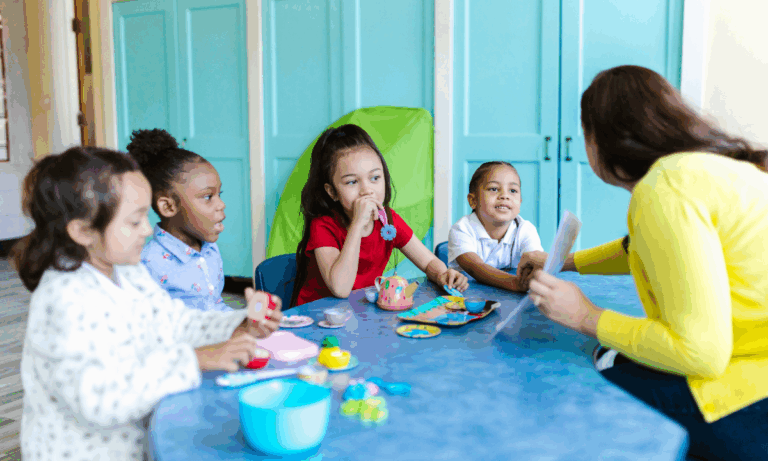
Your child arrives and is greeted by their key person. After a short welcome circle, the room opens up into areas: a home corner for role play, blocks, a mark-making table, sand and water. Teachers join in and ask questions, and they draw a few children into a planned activity, such as counting objects or a sound game. Outdoor play, snack and a story usually follow, with time for songs and group movement.
In a Montessori Classroom
Your child arrives, hangs up their bag and chooses work from the shelves: perhaps pouring water between jugs, then tracing sandpaper letters. The guide invites them for a short lesson with a new material, then leaves them to repeat it as often as they like. When they finish, they return the material to its shelf. Whole-group time is brief, and the room tends to be calmer and quieter.
Montessori vs EYFS: What the Research Says
The best-known recent study is a 2017 longitudinal study by Angeline Lillard and colleagues. It followed 141 children aged 3 to 6 who had entered a lottery for places at two public Montessori schools in Hartford, Connecticut. By the end of the study, children who won places had better scores on academic achievement, social understanding and willingness to persist with difficult tasks. The researchers found no difference in creativity or social problem solving.
The authors are careful about limits. The schools were high-fidelity, AMI-recognised Montessori programmes, and the authors note that less rigorous programmes may not show the same effects. The study compared Montessori with a mix of other preschools, not with the EYFS specifically.
The EYFS is harder to study as a single programme, because it’s a framework that nurseries deliver in different ways. The fairest reading of the evidence is this: how well an approach is delivered matters as much as its name.
Why Many UAE Nurseries Blend the Two
The EYFS sets learning goals but doesn’t prescribe a teaching method. That means a nursery can follow the EYFS areas and goals while using Montessori materials or practical-life activities. There’s nothing wrong with a blend. It simply means you need to ask what the blend looks like day to day.
The opposite caution applies to the Montessori label itself. AMS notes that the word cannot be trademarked, so anyone can open a school and call it Montessori, whatever its practice. A room with some wooden toys isn’t necessarily a Montessori classroom.
Which Approach Suits Your Child?
Neither approach is “better” for every child. The more useful question is which one fits your child and your plans.
An EYFS nursery may suit your child if:
- You plan to move them to a British-curriculum school, where FS2 continues the same framework
- They love pretend play, group songs and stories
- You’d like regular written updates on their progress
A Montessori setting may suit your child if:
- They concentrate on one task for a long time and enjoy repetition
- They like order, routine and doing things for themselves
- You value mixed-age classrooms and a quieter room
Two things apply whichever you choose. First, the UAE’s 31 December age cut-off decides when your child moves to FS1 or KG1, so check your child’s dates against our nursery admission timeline. Second, SPEA launched its “Arabic Is My Language” framework in November 2026 to guide how Arabic is taught in Sharjah’s private nurseries, from birth to age four. Ask any nursery you visit how it is applying it.
Questions to Ask on a Nursery Tour
For any nursery:
- Which framework or method do you follow, and how were your teachers trained in it?
- Can I observe part of a normal morning?
- How do you introduce Arabic, and how will you apply SPEA’s new framework?
If the nursery says it is EYFS:
- How do you balance child-led play with adult-led activities?
- Who will be my child’s key person?
- How and how often will you share progress, and do you complete the progress check at two?
If the nursery says it is Montessori:
- Is it recognised by AMI or accredited by AMS, and are the guides Montessori-trained?
- Are classes mixed-age?
- How long is the uninterrupted work period each morning?
For a wider set of questions, use our nursery visit checklist.
How We Approach Learning at 5 Kids Nursery
At 5 Kids Nursery, we follow a British EYFS curriculum built around play, talk and hands-on discovery. Children learn in age-based classes: a Toddler Class (18 months to 2 years), a Pre-Foundation Class (2 to 3 years) and a Foundation Class (3 to 4 years) that prepares them for school.
Working parents can combine classes with our full-day daycare in Sharjah. The best way to judge any approach is to see it with your own eyes, so book a visit and spend some time in a classroom, or start your admission when you’re ready.
Frequently Asked Questions
Is Montessori better than EYFS?
Not for every child. Research on high-quality Montessori programmes shows benefits, but it compares Montessori with a mix of preschools, not with the EYFS. How well a nursery delivers its approach matters as much as which one it follows.
Can a nursery follow both EYFS and Montessori?
Yes. The EYFS sets learning goals without prescribing a teaching method, so some nurseries use Montessori materials within it. Ask how the two fit together in a normal day.
Will my child find it hard to move from Montessori to a British-curriculum school?
It depends on the child. The main changes are same-age classes and more adult-led group time. Share your child’s nursery records with the new school and ask what a typical FS1 or FS2 day looks like.
Does an EYFS nursery mean worksheets for toddlers?
It shouldn’t. The framework describes play as essential, and more direct teaching of skills such as reading and writing comes later, in the final EYFS year (FS2).
Do Sharjah nurseries teach Arabic?
SPEA’s “Arabic Is My Language” framework, launched in November 2026, guides Arabic learning in private nurseries for children from birth to four. Ask each nursery how and when Arabic is part of the day.